In this article
- What an SEO marketing agency should share with your ads team
- Build one intent map before creating more pages
- Protect landing pages with clear change control
- Agree on conversions before comparing channel results
- Verify case studies at the business-result level
- Give shortlisted agencies a collaboration scenario
- Choose agency structure around the work, not the label
- Put coordination, ownership and costs in the contract
- Use the first 90 days to test the working relationship
- Frequently asked questions
- Start with your current search setup
An SEO marketing agency can improve your organic visibility without making life easier for your ads team. Separate keyword plans, conflicting landing-page changes and incompatible conversion reports can leave both partners claiming success while your cost per qualified lead stays flat. Choosing well means evaluating how the agency will work with the people already managing your paid search.
The strongest arrangement is not necessarily one agency doing everything. A specialist SEO provider and an independent Google Ads team can work together effectively when they share business goals, exchange useful data and agree on who controls website changes. A full-service agency can still operate in silos if those habits are missing.
Use the following criteria to assess proposals, interview the people who will handle your account and put collaboration into the scope of work. The objective is better search performance overall, not two impressive reports that tell different stories.
What an SEO marketing agency should share with your ads team
Start with the information each team needs from the other. Giving everyone access to a dashboard is not enough. They need a process for turning findings into decisions.
Your paid search team can contribute search-term reports, conversion performance, location trends and messages that generate qualified enquiries. Those reports have limits: Google Ads does not expose every search term, and an expensive query is not automatically an organic opportunity worth pursuing.
The SEO team should contribute Google Search Console findings, technical issues, content priorities and changes to important pages. Organic query data can reveal customer language that paid campaigns have not deliberately tested.
A workable exchange should answer four questions:
- Which searches bring customers who fit the business?
- Which pages serve both paid and organic visitors?
- What did one team learn that the other should test?
- Which upcoming changes could affect the other channel?
Assign a named contact on each side and a shared place for decisions. A monthly meeting may suit a stable account, while a website migration or campaign launch needs closer coordination. The agreement should specify the cadence rather than promise vague “ongoing communication”.
Build one intent map before creating more pages
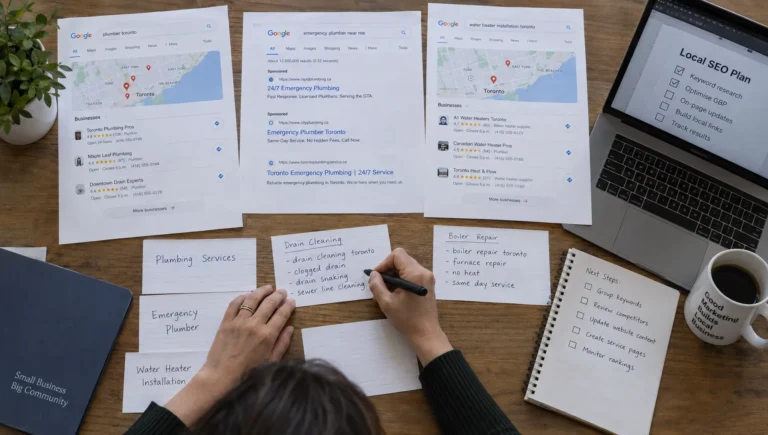
Ask your SEO marketing agency to connect its keyword research to the ads team's existing search strategy. You do not need identical keyword lists. You need agreement about intent, destinations and the commercial value of each search group.
For a Canadian plumbing business, a simplified planning sheet might look like this:
| Search intent | Organic priority | Paid search coordination |
|---|---|---|
| Emergency plumber in Calgary | Accurate local service page with clear availability | Confirm that ads, service area and landing-page claims match |
| Water heater replacement cost | Useful pricing guidance with an appropriate enquiry path | Test whether visitors become qualified replacement enquiries |
| Business-name searches | Clear brand information and contact details | Review branded spending separately from customer acquisition |
| How to stop a dripping tap | Helpful troubleshooting content with safety boundaries | Avoid assuming informational traffic deserves acquisition budget |
This prevents two common problems: commissioning duplicate pages and treating every high-volume keyword as commercially valuable.
Have each team identify the intended page before content production starts. If a paid campaign needs a different offer or layout, a separate landing page may be appropriate. Decide its indexing and canonical treatment deliberately rather than applying a blanket rule to every campaign page.
Revisit the map when services, seasonality or service areas change. It should be a working plan, not a spreadsheet delivered once during onboarding.
Protect landing pages with clear change control
Shared landing pages are where collaboration becomes operational. An SEO marketing agency might recommend a new heading, longer copy or different internal links on the same page your ads team is testing for enquiries.
Neither team should have unrestricted permission to change a commercially important page without notifying the other. A sensible approval process records the proposed change, the affected URLs, the reason for the work and the person approving publication.
Require a rollback option for substantial changes. Navigation updates, form replacements, redirects and tracking changes deserve particular attention because their effects can extend beyond organic rankings.
Before a shared page goes live, check that:
- Forms, phone links and booking steps work on mobile.
- Ad promises match the page's offer, geography and availability.
- Conversion events still fire as intended.
- Redirects, indexability and canonical tags match the agreed plan.
- The team can restore the previous version if necessary.
Improving page speed and usability can benefit visitors from both channels. It does not guarantee higher rankings or a particular Google Ads Quality Score.
Ask candidates to explain how they would handle an urgent technical fix during a paid landing-page experiment. Their answer should balance business risk with the need to keep the experiment interpretable.
Agree on conversions before comparing channel results
Your SEO marketing agency and ads team should use the same business definition of a successful lead, even when their platforms report different totals.
A submitted form might be spam, a job application or an enquiry outside your service area. A phone call might come from an existing customer. Counting every interaction as new business makes both channels look better than they are.
Define the progression from enquiry to qualified lead, booked appointment and sale. Then decide which system records each stage. For many businesses, the CRM is the practical source for lead quality and sales outcomes, while Google Analytics 4 and Google Ads help explain acquisition and campaign activity.
Do not add platform-reported conversions together and call the result unique customers. Attribution models, reporting dates, conversion windows and cross-device behaviour can produce different totals for the same underlying activity.
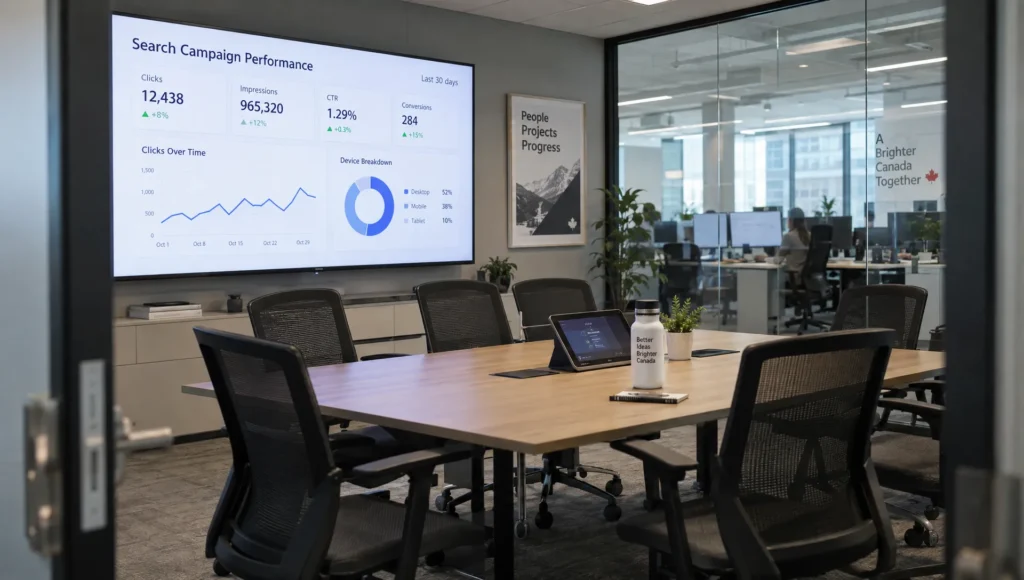
The shared report should distinguish branded from non-branded search and show lead quality alongside volume. Where reliable revenue data exists, include it with an explanation of attribution limitations.
For example, a person may discover your business through an organic guide, return through a branded ad and then call. The teams should explain how that journey is counted rather than each claiming an entirely separate customer.
Keep personal information out of analytics fields where it does not belong. Require appropriate access controls and review consent, call-recording practices and data handling against the Canadian privacy requirements applicable to your business.
Verify case studies at the business-result level
A persuasive case study needs more than a traffic chart. Ask an SEO marketing agency to explain what changed in the business, what work it performed and what else happened during the same period.
Useful evidence includes the starting position, project dates, implemented changes and a consistent definition of conversions. If the headline result is “leads doubled”, establish whether that means form submissions, qualified enquiries or customers.
Paid search activity matters here. Increased advertising, a stronger promotion or expansion into a new city can influence branded searches and overall lead volume. Conversely, organic growth during a paid budget reduction needs context before anyone claims that SEO replaced advertising.
Ask for separate organic and paid trends, with branded demand identified where possible. A redacted report or reference call can help verify the agency's role without exposing confidential client information.
Also ask what failed and what the team changed. A credible partner should be able to describe a page that did not perform or an assumption that required revision.
If you are reviewing several proposals, use the same evidence requests for each. MarketingFlow's guide to comparing SEO providers beyond their sales pitches provides a broader framework for making those comparisons consistent.
Give shortlisted agencies a collaboration scenario
A short working discussion can reveal more than another presentation. Give each shortlisted SEO marketing agency the same realistic scenario and ask how it would investigate it with your ads team.
For example: organic enquiries have increased, paid enquiries have fallen and the sales team says overall lead quality is worse. What would the agency check first?
| Issue to investigate | What a useful answer includes |
|---|---|
| Measurement changes | Checking forms, event definitions, attribution settings and CRM records |
| Demand changes | Separating brand demand, seasonality, location and service mix |
| Website changes | Reviewing releases, redirects, page content and conversion paths |
| Lead quality | Comparing enquiry categories and sales outcomes, not just totals |
The candidate should not declare a winner between SEO and paid search from those facts alone. It should identify missing evidence and explain which team would retrieve it.
Ask who would attend the discussion after you sign. A convincing strategist in the sales meeting does not establish that the day-to-day account team has the same capability.
Keep this exercise proportionate. You are assessing reasoning and coordination, not requesting a free strategy project. A brief discussion using hypothetical or safely redacted data should be enough to expose whether the agency can work across channel boundaries.

Choose agency structure around the work, not the label
A local specialist may understand your service areas and Google Business Profile requirements particularly well. A national firm may offer broader capacity across locations. A full-service agency may simplify coordination by putting SEO and advertising under one roof.
Those are possible advantages, not guarantees. Ask who performs the work, which activities are subcontracted and whether the SEO and paid search teams actually share planning and reporting.
For a business serving one Canadian city, local relevance and accurate service-area information may outweigh a large account team. For a multi-location business, consistent implementation and coordination across locations may matter more than office proximity.
An SEO marketing agency selling AI-search visibility should also explain its deliverables plainly. Technical accessibility, useful content and documented visibility checks are assessable work. A promise to “dominate AI answers” is not a measurement plan, and placements can vary by platform, query and time.
If the proposal includes AI automation or reporting tools, apply the same scrutiny to data access, subcontractors and ongoing support. Impulse Lab's guidance on evaluating local AI agencies beyond proximity offers relevant vendor checks for that part of the proposal. It does not replace checking the agency's SEO results or collaboration process.
Put coordination, ownership and costs in the contract
A proposal should turn collaboration promises into named responsibilities. Your SEO marketing agency should specify whether it is providing recommendations, implementing changes or doing both.
“Landing-page optimization” could mean a written audit or published improvements. “Monthly reporting” could mean a dashboard link or a meeting that includes your ads manager. Those differences affect both cost and execution.
Check the agreement for the following:
- Deliverables: Defined work, priorities and how completion will be confirmed.
- Coordination: Meeting frequency, named contacts and responsibility for shared decisions.
- Implementation: Who edits the website, approves changes and fixes tracking problems.
- Ownership: Control of accounts, content, reports and relevant project files.
- Commercial terms: Setup fees, taxes, third-party costs and charges for extra coordination.
- Exit terms: Cancellation notice, access handover and treatment of unfinished work.
Your business should retain administrative control of its core accounts, with agencies receiving appropriate permissions. Avoid arrangements where one vendor's departure could lock out your ads team or interrupt access to historical data.
For a more detailed asset review, use this guide to account and content ownership when comparing SEO companies.
There is no useful agency price comparison without scope. A limited local SEO plan and a multi-location engagement involving development, content production and weekly paid search coordination are different purchases. Ask what is included before comparing retainers.
Use the first 90 days to test the working relationship
Treat the opening months as a way to evaluate execution, not as a guaranteed ranking deadline. An SEO marketing agency should be able to demonstrate useful progress even before organic growth becomes substantial.
First month: establish a trustworthy baseline
Confirm account access, conversion definitions, priority services and important landing pages. Review technical risks and document the existing paid search tests. Both teams should know which reported numbers can be trusted and which need repair.
Second month: complete coordinated work
Look for implemented fixes and approved content or landing-page improvements, not just a longer task list. Check whether the teams exchanged findings and whether website changes followed the agreed approval process.
For example, paid search evidence might support prioritizing a service page, while organic query data might suggest an advertising test. Neither insight proves the outcome in advance.
Third month: review outcomes and adjust
Assess completed work, qualified enquiries and any meaningful visibility changes against the baseline. Explain seasonality, campaign changes and measurement repairs before interpreting the trend.
Paying for ads does not buy better organic rankings. Google's guidance on hiring an SEO explicitly separates advertising from organic search inclusion and rankings. The value of coordination is better decisions and execution, not a shortcut between the two systems.
Frequently asked questions
Should one company manage SEO and Google Ads? Not necessarily. Separate specialists can work effectively when responsibilities, access and measurement are clear. A single provider is useful only if its teams genuinely coordinate. Ask to see the proposed workflow rather than assuming a full-service label solves the problem.
Can an SEO marketing agency help reduce advertising costs? It may help attract qualified organic demand and identify useful landing-page improvements. That does not automatically justify reducing ad spend. Assess total qualified leads, revenue and customer acquisition costs before changing budgets, especially where branded ads account for a large share of reported conversions.
What should both teams review together? Review qualified leads, sales outcomes where available, branded versus non-branded demand, shared landing-page performance and upcoming website changes. Keep channel-specific metrics for diagnosis, but connect them to agreed business outcomes.
How long should SEO take to show results? There is no universal deadline. Competition, site condition, implementation speed and search demand all affect progress. Require early delivery milestones and a reasoned forecast, then judge business results over a period appropriate to the work rather than accepting guaranteed first-page dates.
Start with your current search setup
Before requesting proposals, gather your paid search objectives, priority landing pages, lead definitions and known tracking problems. Ask candidates how they would work within that setup and what they would need from your ads team.
MarketingFlow offers local SEO, Google Maps optimization, technical and on-page SEO, content writing and backlink building across Canada. Its SEO services start at $99 per month with no long-term contracts. Bring your ads team's requirements to a free SEO audit and confirm which coordination and implementation tasks belong in your proposed scope.