In this article
- Understand what buyer intent actually looks like
- Start SEO keyword research with the customer’s buying situation
- Use tools to expand and validate, not make the decision
- Inspect the search results before assigning intent
- Score business fit before search volume
- Validate demand for the Canadian market you serve
- Group related searches into one useful destination
- Account for AI answers without chasing speculative tactics
- Turn priorities into a measurable content plan
- Frequently asked questions
- Build a shortlist worth acting on
SEO keyword research should help you find the searches that lead to worthwhile customers, not simply the searches with the largest volume. A phrase that attracts hundreds of curious readers can be less valuable than a specific query from someone ready to request a quote.
For Canadian businesses, that means evaluating more than keywords and rankings. You need to understand what the searcher wants, whether you can serve them and which page would help them take the next step. This guide provides a buyer-first framework for making those decisions before you invest in content.
Understand what buyer intent actually looks like
Buyer intent is evidence that someone is moving towards a purchase. It is not a guarantee that they will buy, and it does not always announce itself with words such as “hire” or “price”.
A person comparing commercial cleaning contracts may be closer to a decision than someone searching for the cheapest cleaning supplies, even though both queries involve money.
| Search pattern | Possible intent | Suitable content |
|---|---|---|
| “how to clean office carpets” | Learn a process, possibly do it themselves | Practical guide |
| “commercial carpet cleaning cost” | Assess budget and suitability | Pricing explanation |
| “office carpet cleaning companies Calgary” | Compare available providers | Relevant service page |
| “commercial carpet cleaning quote Calgary” | Contact a provider | Service page with a clear enquiry path |
These are starting hypotheses. The actual results page may reveal a different expectation. Buyer intent comes from the whole query and its context, not one modifier.
Start SEO keyword research with the customer’s buying situation
Before opening a tool, define the sale you want to generate. Record the service or product, ideal customer, service area and conditions that make an enquiry commercially worthwhile.
For an office cleaning company, “commercial cleaning” is only a seed term. The useful buying situations might include replacing an unreliable contractor, arranging after-hours cleaning or requesting a contract for a medical office. Each situation suggests different searches and different proof requirements.
Use sales calls, quote requests, customer emails and internal site searches to collect the language buyers already use. Ask sales staff which questions consistently appear before a purchase, rather than which questions they hear most often.
This applies to specialist businesses too. A rights holder evaluating music rights monitoring and licensing support has a different need from a student researching copyright definitions. Terms about detecting unauthorised commercial use may indicate a service need, even without a “buy” modifier.
Write a short hypothesis for each opportunity: “This person needs X, is deciding Y and would find our offer relevant because Z.” If you cannot complete that sentence convincingly, keep the term in a research backlog rather than making it a publishing priority.
Use tools to expand and validate, not make the decision
Tools make SEO keyword research faster, but their outputs should support your commercial judgement rather than replace it. Start with a small set of buying situations, then collect variations and related questions.
| Tool or source | Useful contribution | Important limitation |
|---|---|---|
| Google Search | Autocomplete, related searches and visible page formats | Suggestions are not reliable volume measurements |
| Google Search Console | Queries already generating impressions and clicks for your site | It does not reveal every query or the whole market |
| Google Keyword Planner | Keyword ideas and demand estimates with location settings | Advertising competition is not organic ranking difficulty |
| Ahrefs or Semrush | Competitor discovery, keyword estimates and difficulty metrics | Coverage and scoring methods vary between tools |
Google Keyword Planner is free to use within Google Ads, although account setup and the detail available can vary. You do not need a paid SEO subscription to start gathering useful evidence.
Search volume and keyword difficulty are estimates, not promises. A low-volume label does not prove there is no demand, particularly for specialised B2B services or smaller Canadian markets.
If you need help assembling the initial spreadsheet, MarketingFlow’s step-by-step keyword research guide covers that process. Keep this shortlist focused on commercial relevance rather than collecting every variation a tool returns.
Inspect the search results before assigning intent
The next stage of SEO keyword research is checking what Google currently rewards for each candidate. Search from the relevant market where possible and note the location, date and device context. Results can vary.
Look at the leading organic pages and the surrounding features. Are you seeing service businesses, product categories, directories, comparison articles, videos or a local map pack? Open several results and inspect what users can actually do on those pages.
A query containing “best” might favour independent comparisons rather than a provider’s service page. A query containing “cost” might favour detailed explanations rather than a short contact form. If the expected format differs from your planned page, change the page or reconsider the keyword.
Also check whether the apparent demand belongs to your business. “Office cleaning jobs Toronto” is location-specific, but it attracts jobseekers rather than clients. “Free contract template” may attract business owners without indicating demand for your service.
Record a one-line conclusion: expected intent, dominant page type and the action your page should support. When the results are mixed, investigate more specific variations instead of forcing one page to satisfy unrelated needs.
Score business fit before search volume
A useful SEO keyword research scorecard makes trade-offs visible. The following is an optional editorial framework, not an industry standard or a prediction of Google rankings.
Score each factor from 0 to 3, then apply the weight shown.
| Factor | What a high score means | Weight |
|---|---|---|
| Offer and customer fit | You serve this buyer, location and requirement profitably | ×3 |
| Purchase proximity | The query suggests active evaluation or supplier selection | ×3 |
| Search-result feasibility | Your available expertise, page format and site strength make the opportunity plausible | ×2 |
| Demand evidence | Tools, existing impressions or customer enquiries support the opportunity | ×1 |
The maximum score is 27. Use it to compare opportunities within your business, not against another company’s spreadsheet. Exclude searches outside your service area or capabilities before scoring them.
Next, record production effort separately. A promising service-page improvement may deserve attention before a slightly higher-scoring topic that requires extensive original research. The score should inform judgement, not conceal the work involved.
Consider customer value too. A query associated with recurring contracts can justify more effort than one associated with a low-margin, one-off purchase. When reliable data exists, compare expected qualified enquiries, close rates and contribution after delivery costs. Do not invent those inputs to make an attractive keyword look profitable.
Validate demand for the Canadian market you serve
Location settings are essential to SEO keyword research for Canadian businesses. National search volume can hide the fact that most demand sits outside your service area, while a smaller local query may represent customers you can actually serve.
Set the relevant country, province or city in tools that support those controls. Compare explicit location searches with broader terms that produce local results. Someone typing “accountant near me” and someone typing “small business accountant Winnipeg” may need the same local service page.
Collect spelling variations such as “centre” and “center” when they appear in customer language or query data. Use Canadian spelling naturally in your copy, but do not create duplicate pages solely to capture spelling differences.
For businesses serving Quebec or other francophone audiences, research French queries independently. A literal translation of an English keyword list can miss how buyers describe the service and what appears in local results.
Finally, check seasonal context. Snow removal and landscaping searches have different buying windows. Prioritise preparation before demand rises, and avoid judging a seasonal opportunity using only its quietest month.
Group related searches into one useful destination
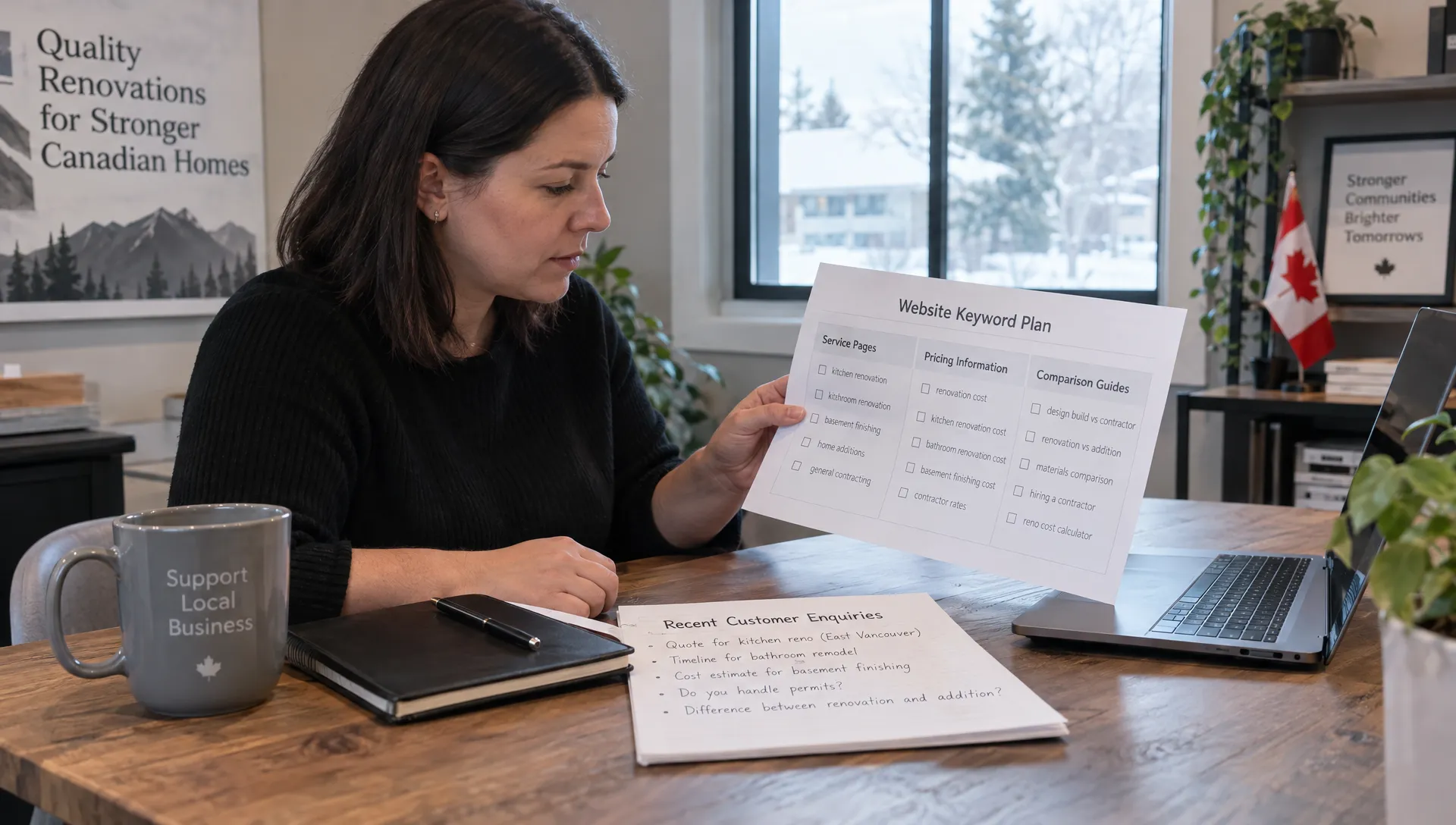
Page mapping turns SEO keyword research into a plan and helps prevent keyword cannibalization, where multiple URLs compete to satisfy essentially the same need.
Group terms when the searcher’s job, expected page format and relevant results substantially overlap. For example, “commercial cleaning quote Ottawa” and “office cleaning estimate Ottawa” may belong on one service page if they describe the same offer.
Separate terms when users need materially different information or services. Medical-office cleaning may warrant its own page if you genuinely provide it and can explain relevant processes, requirements and experience. Changing a heading and city name is not enough to justify another URL.
Give each cluster a preferred destination and check whether that page already exists. Improving an established page is often more sensible than publishing a competing one. Multiple ranking URLs are not automatically a problem, but repeated switching between near-identical pages deserves investigation.
For every planned page, record its primary intent, supporting queries, existing URL and conversion action. The goal is one clear destination per distinct need, not one page per keyword.
Account for AI answers without chasing speculative tactics
AI Overviews and other answer features can satisfy some questions directly on the results page. That makes it especially useful to distinguish between a query someone can resolve in a short explanation and a task that still requires a supplier, detailed comparison or transaction.
Do not automatically discard informational topics. A detailed answer about contract terms, installation requirements or service limitations can help a buyer decide. Give that page a clear role in the buying journey and link it to the relevant offer.
Google’s guidance on AI search features says established SEO practices remain relevant. Clear content, accessible pages and useful supporting evidence are more defensible investments than speculative formatting tricks.
For SEO keyword research, the practical adjustment is to consider the likely next action after an answer appears. Prioritise pages that provide something a brief summary cannot complete, such as assessing service fit, reviewing actual work or requesting a tailored quote.
Turn priorities into a measurable content plan
Your final spreadsheet should connect each keyword cluster to an owner, a page and a business outcome. Add the evidence supporting its priority and the next implementation task, such as updating pricing information, improving a service description or creating a genuinely missing page.
Before publishing, confirm that the destination makes the next step easy. A high-intent visitor should be able to understand your service area, assess suitability and find the enquiry route without searching through unrelated content. MarketingFlow’s guide to implementing on-page SEO explains how to carry that page plan into execution.
Measure results at the page and cluster level. Review relevant impressions, clicks and organic landing-page visits alongside quote requests, booked consultations or sales. Where feasible, connect enquiries to qualification and revenue in your CRM, and account for spam and job applications.
The feedback loop is what makes SEO keyword research improve over time. If traffic rises but qualified enquiries do not, inspect intent and page fit before adding more keywords. If relevant impressions grow without clicks, review the results layout and your listing. If qualified enquiries increase from a small query cluster, expand adjacent opportunities rather than abandoning it for a higher-volume term.
Frequently asked questions
What is the difference between commercial and transactional intent? Commercial intent usually involves evaluating options, prices or suitability. Transactional intent suggests readiness to act, such as requesting a quote or purchasing. The boundary is not always clear, so check the results and the buying situation.
Can I do SEO keyword research for free? Yes. Google Search, Search Console and Keyword Planner provide a useful starting point. Combine their evidence with customer conversations and manual results analysis. Paid tools can speed up discovery but do not replace intent validation.
Should I target low-volume keywords? Often, if they closely match a valuable service and a reachable customer. Validate them with relevant impressions, enquiries or sales conversations. A tool’s estimate alone should not decide whether the opportunity is worthwhile.
How often should I review my keyword priorities? Review performance regularly, then revisit priorities when offers, locations, seasonality or search results change. Avoid rewriting the plan in response to every short-term ranking fluctuation.
Build a shortlist worth acting on
Start with one profitable service, identify the buying situations around it and assign the strongest query clusters to useful pages. Expand once the evidence shows which searches attract suitable customers.
If you want help connecting that research to local visibility and enquiries, MarketingFlow offers keyword research, local SEO, content writing and free SEO audits for Canadian businesses. Bring your priority services and target locations so the discussion starts with business fit, not just traffic.