In this article
- 1. Which English- and French-speaking markets should we target first?
- 2. Will you research French keywords independently?
- 3. Who writes and approves the Canadian French?
- 4. How will the technical setup connect equivalent pages?
- 5. What bilingual results can your Canadian SEO company verify?
- 6. How will bilingual SEO work with Google Maps?
- 7. How will you earn relevant links and local mentions?
- 8. How will reporting separate language performance from business results?
- 9. What exactly is included in the bilingual quote?
- 10. What will the first 90 days prove?
- Frequently asked questions
- Bring these questions to your SEO audit
Choosing a Canadian SEO company for English and French search takes more than checking whether its website has a language switcher. You need to know who researches each market, who approves the French and how the agency measures qualified leads in both languages.
A translated website can still target the wrong searches, send visitors to the wrong pages or generate enquiries your team cannot answer. The questions below help you compare proposals, test claimed expertise and put bilingual deliverables into writing before you commit.
1. Which English- and French-speaking markets should we target first?
A credible proposal starts with your customers and service capacity, not an assumption that every Canadian business needs every page in both languages.
Ask the agency to explain which locations justify French-language investment. A Montréal service business, an Ottawa retailer and a national equipment supplier may need different approaches. Province-wide language assumptions are not a substitute for customer data.
Useful inputs include existing enquiries, sales by location, customer interviews and search demand for specific services. Your ability to provide estimates, consultations or support in French matters too. Ranking a French page creates an expectation that the next step will work in French.
A Canadian SEO company should connect its recommended language coverage to commercial opportunities, rather than proposing a complete translation simply because your business operates nationally.
Ask for: A short market-priority document naming the locations, services and language audiences to address first, with the evidence behind each choice.
Also clarify whether the project targets French-speaking Canadians specifically or French speakers internationally. Those audiences can overlap, but they do not automatically need identical terminology, offers or geographic targeting.
2. Will you research French keywords independently?
Ask the agency to demonstrate how it would research one service in English and Canadian French. Do not accept a spreadsheet in which each English keyword has simply been translated into the next column.
Separate research should consider local phrasing, search intent, regional competitors and the language people use when they are ready to buy. Equivalent services may attract different questions or require different page structures in each market.
For specialised businesses, terminology makes this test especially useful. Consider a technical catalogue such as Dahab Miners’ ASIC mining hardware, hosting and repair services. Those represent distinct customer needs. A bilingual research exercise should preserve the difference between buying equipment, hosting equipment and repairing it, rather than grouping everything under one broad translated phrase.
Have the Canadian SEO company show how it would validate unfamiliar French terminology through search results, customer language and review by someone who understands the subject.
Ask for: A sample keyword-to-page map containing the target audience, search intent, proposed page and reason for choosing each topic.
Low reported search volume should prompt investigation, not automatic rejection. Niche B2B terms may produce few searches but still describe valuable purchase intent. The agency should explain that judgement rather than treating volume as the only selection criterion.
3. Who writes and approves the Canadian French?
“Bilingual team” is too vague to evaluate. Ask who performs keyword research, who drafts the content and who has final approval over its language and technical accuracy.
The person reviewing the French should understand the intended Canadian audience and your sector. A fluent generalist can still misunderstand insurance terminology, construction services or a regulated professional claim.
Machine translation can support production, but the proposal should distinguish draft generation from editorial approval. Find out whether a qualified reviewer checks the title tag, headings, body copy, calls to action and form messages. Those smaller elements often determine whether a page feels trustworthy.
Your Canadian SEO company should also explain how approved terminology will remain consistent when different writers or subcontractors work on the account.
Ask for: An anonymised before-and-after editing sample, the reviewer’s relevant experience and a small paid test if you need stronger evidence.
Make the approval process practical. Identify who on your team confirms service details and who resolves language disagreements. Where Quebec is in scope, have a qualified legal reviewer assess applicable French-language requirements. SEO review does not establish legal compliance.
4. How will the technical setup connect equivalent pages?
Ask the agency to walk through one English service page and its French equivalent, from discovery in Google to submitting an enquiry.
Google’s guidance on localised page versions explains how hreflang annotations identify language and regional alternatives. The important buying question is whether the agency can implement and validate the relationships correctly, not merely whether it recognises the term.
| Component | What a sound proposal should address | Warning sign |
|---|---|---|
| Separate URLs | Stable, crawlable URLs for each language version | Content changes only through browser settings or cookies |
| Hreflang | Accurate language or language-region codes, with reciprocal references | Tags point to missing or unrelated pages |
| Canonicals | Each distinct translated page normally identifies its own preferred URL | Every French page canonicalises to English |
| Language switcher | Visitors can reach the equivalent page in the other language | Every switch sends visitors to the homepage |
| Indexing checks | Important URLs are checked for crawlability and indexability | The agency assumes installation means everything works |
Codes such as en-CA and fr-CA can suit pages intended for Canadian audiences. They should reflect the targeting strategy rather than being added mechanically.
A Canadian SEO company should document these decisions and test the live site after deployment. Avoid forced language redirects that prevent visitors from choosing their preferred version or make alternate pages difficult to access.
5. What bilingual results can your Canadian SEO company verify?
Request evidence that separates English performance from French performance. An impressive site-wide traffic chart does not establish that an agency can grow both.
A useful case study identifies the starting problem, work completed, timeframe and business outcome. It should clarify whether the agency inherited existing French content, created a new language section or fixed a technical problem.
Ask to see date ranges and page-level examples in a live walkthrough or appropriately anonymised report. A ranking screenshot without a location, language context or comparison period tells you little. A rise in branded searches may reflect advertising or wider brand awareness rather than the SEO work being discussed.
Ask for: One relevant case study and, where possible, a reference from a client with a comparable bilingual challenge.
Verify the reference independently through the business’s established contact details. Ask what the agency actually delivered, how revisions were handled and whether reporting matched the agreed scope.
Confidentiality can reasonably limit access to client data. In that case, an anonymised walkthrough or clearly labelled demonstration is more useful than unsupported claims. Demonstration data should never be presented as a real client result.
6. How will bilingual SEO work with Google Maps?
Local visibility requires attention to the actual business, not just the language of a landing page. Ask how the agency will handle your Google Business Profile, location pages and enquiries from each language audience.
Google’s Business Profile representation guidelines require businesses to represent themselves accurately. A proposal to create duplicate English and French profiles for the same business location is a warning sign. So is adding translated service keywords to a business name that does not use them in the real world.
Ask how categories, services, website links and location information will be maintained within the platform’s available options and rules. Where you have multiple legitimate locations, each needs accurate information and an appropriate website destination.
The Canadian SEO company you hire should connect local visibility with a workable customer experience: the right location, an appropriate landing page and a team able to respond.
Ask for: A location-by-location plan showing profile ownership, landing-page destinations and responsibility for answering reviews and enquiries.
French-language leads should not arrive at an English-only booking form without warning. Test the complete journey, including confirmation emails and any third-party scheduling system.
7. How will you earn relevant links and local mentions?
Bilingual link building should follow audience relevance, not a quota of French-language domains.
Ask where the agency expects to find legitimate opportunities: industry associations, regional publications, supplier relationships or local organisations with a genuine connection to your business. A relevant English-language trade publication may be more useful than an unrelated French-language website, and the reverse can also be true.
Request sample placements and inspect the surrounding content. Does the publication have a recognisable audience? Is the linked page useful in that context? Does the article appear to exist mainly to hold unrelated commercial links?
Ask for: The outreach approach, placement standards and a clear explanation of any paid arrangements. Ask how the agency avoids link schemes and handles opportunities that do not meet its standards.
Be cautious when the main promise is a fixed quantity of “high-authority” links. Third-party authority scores are not Google metrics, and a numerical score does not establish editorial quality or commercial relevance.
8. How will reporting separate language performance from business results?
Ask to see the proposed report before signing. It should help you decide what to improve, not merely confirm that work happened.
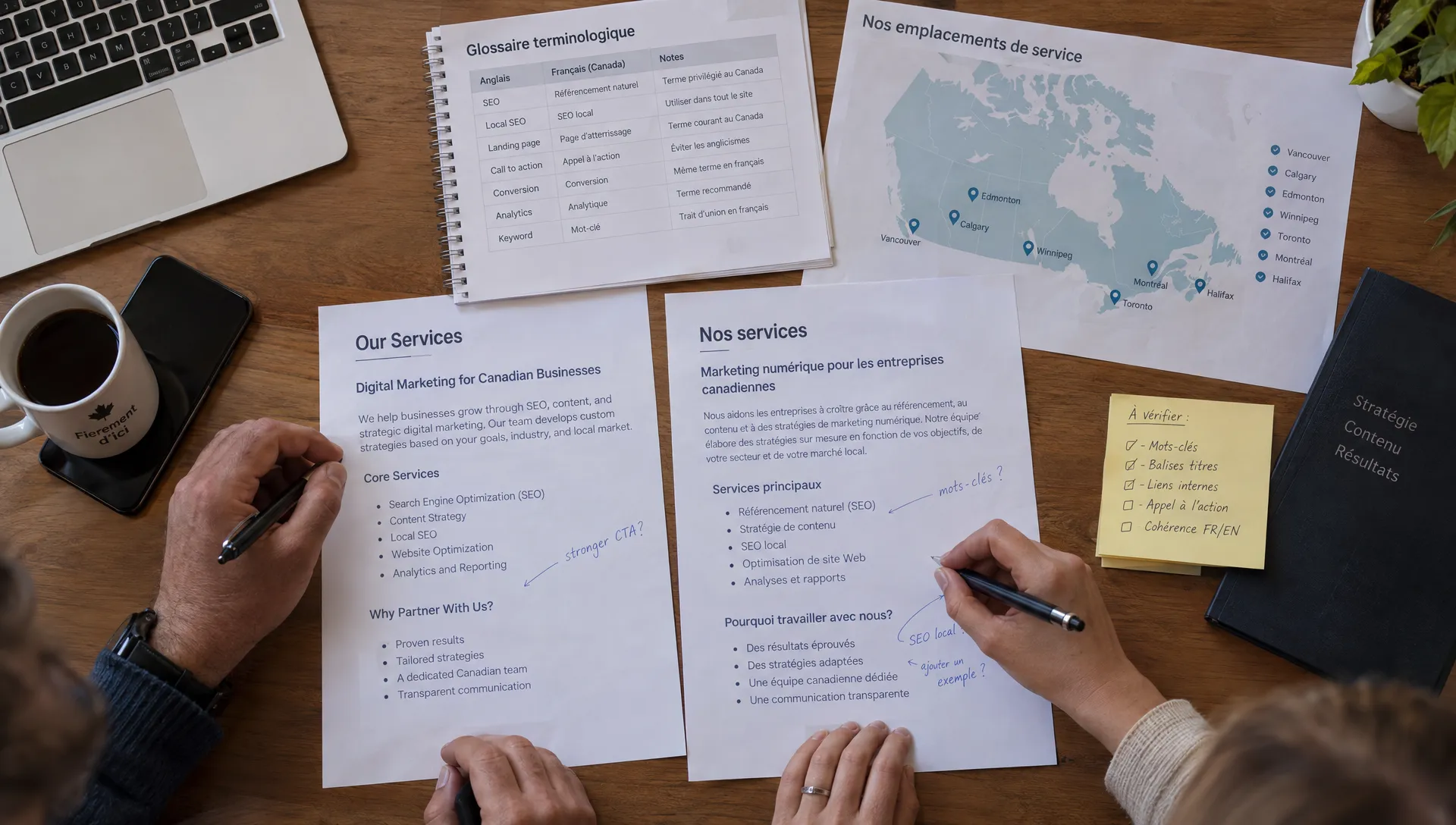
Separate English and French landing-page groups in reporting, then examine search visibility and conversions for each. In Google Search Console, page groups, country filters and available query data can help reveal differences. Query reporting is incomplete, so the agency should not imply it can identify every search or confidently classify every short query by language.
Analytics needs similar care. A browser language setting is not proof of someone’s preferred service language. Landing-page language, an optional form-language preference and your team’s lead records provide different pieces of evidence.
A Canadian SEO company should distinguish organic enquiries from qualified opportunities and sales wherever your measurement setup allows it.
Ask for: A sample report showing language-specific landing-page performance, conversion definitions, completed work and next actions.
Agree on what counts as a conversion. A form submission, booked consultation and qualified sales opportunity are different events. If calls are central to your business, ask how call attribution will work and what its limitations are.
Reporting should also disclose tracking changes. A new consent setup or revised form can change recorded conversions without reflecting a real change in demand.
9. What exactly is included in the bilingual quote?
Bilingual delivery involves more than doubling a page count. Research, writing, editing, technical configuration and ongoing updates all need an owner and a budget.
Ask whether the quoted fee includes independent French keyword research, original content, translation review and implementation. Clarify whether an English and French version count as one deliverable or two. Check revision limits and what happens when a service changes in both languages.
A Canadian SEO company should price the agreed scope transparently, including any subcontracted language review or additional development work.
MarketingFlow’s SEO pricing and monthly plans provide a starting point for comparing service levels. Its plans start at $99 per month with no long-term contracts, but you should confirm the scope and cost of any bilingual work rather than assume a starting price includes a complete two-language programme.
Ask for: A written scope separating one-time setup, recurring work, language-specific deliverables and optional costs.
Also establish ownership of website content, analytics properties and Business Profile access. Your business should retain control of its accounts. Ask what files, documentation and unfinished work you receive if the relationship ends, along with any notice requirements.
10. What will the first 90 days prove?
A short initial plan should make the agency’s approach observable without promising rankings by an arbitrary deadline.
One reasonable sequence is to establish the baseline and resolve critical technical issues first, then publish or improve a small group of priority bilingual pages. The next stage is to validate indexing, test enquiries and review the available performance data. The exact sequence depends on your starting point.
Ask the Canadian SEO company to define acceptance criteria for work it controls. These might include functioning language links, approved terminology, validated page annotations and correctly recorded test conversions.
Ask for: A plan naming each deliverable, its owner, its dependencies and how completion will be checked.
Distinguish delivery milestones from search outcomes. Publishing approved pages is controllable; earning a particular ranking by day 60 is not. Low-volume services may also need longer observation periods before conversion patterns become meaningful.
Before approving a large rollout, use a small set of pages to expose weaknesses in research, editing or implementation. Fixing a broken approval process on four pages is easier than repairing it across an entire bilingual website.
Frequently asked questions
Does every Canadian business need a bilingual website? No. The decision should reflect customer demand, service locations, operational capacity and applicable legal requirements. Some businesses can begin with priority French-language services rather than translating every existing page.
Is automatic translation enough for bilingual SEO? It can help produce a draft, but it does not replace independent keyword research, subject-matter review or technical testing. Unreviewed terminology and broken enquiry journeys can undermine otherwise readable content.
Do we need a separate domain for French? Not necessarily. Separate language sections on one domain can work well. The agency should explain the trade-offs involving maintenance, geographic targeting and your existing website before recommending a structure.
How soon should we expect results? There is no reliable universal deadline. Site condition, competition, publishing capacity and demand all matter. Require clear delivery milestones and a measurement baseline, then assess search and lead trends over a period appropriate to your market.
Bring these questions to your SEO audit
Use these questions to request evidence, a sample deliverable and a written scope from each shortlisted Canadian SEO company. Compare what each agency can demonstrate, not just what it promises.
If you want a starting assessment, request a free SEO audit from MarketingFlow. Identify your English- and French-language priorities upfront and ask which technical, content and measurement issues should be addressed first.