In this article
- Separate the audit from the actual service
- Validate technical SEO services with delivery evidence
- Demand tickets with measurable acceptance criteria
- Separate SEO advice from implementation costs
- Require release tests, not just completed tasks
- Check platform and Canadian requirements
- Set a realistic first-90-day delivery plan
- Measure technical outcomes and business impact separately
- Frequently asked questions
- Start with a scoped assessment
An audit can identify hundreds of website issues without making your business any easier to find. When you compare technical SEO services, the real question is what happens after those issues appear in a report: who fixes them, how changes reach production and what evidence confirms they worked.
For a Canadian business, that evaluation also needs to account for developer capacity, English and French content where relevant, regional service pages and customer data. This guide focuses on the deliverables, contract terms and verification methods that distinguish a useful technical engagement from a recurring diagnostic report.
Separate the audit from the actual service
An audit is a snapshot of findings. A technical SEO engagement should turn relevant findings into prioritized work, then support implementation and verification. Those are different deliverables, and a proposal should distinguish them.
For example, discovering conflicting canonical tags does not resolve the underlying template problem. Someone must determine the intended URL, change the template, test representative pages and confirm that the production site now sends consistent signals.
Ask the provider to describe its delivery process using one issue from diagnosis through release. A credible answer should cover the affected pages, business consequence, recommended fix, implementation owner and acceptance test.
The useful unit of work is a verified fix, not an audit finding. That does not mean every provider must write code. An advisory arrangement can work well when you have developers available, provided the responsibilities and handoffs are explicit. What matters is whether the engagement closes the gap between identifying a problem and resolving it.
Validate technical SEO services with delivery evidence
Request a redacted example of an implemented recommendation, not just a polished audit deck. The example should show what was wrong, why it mattered, what changed and how the agency checked the result.
A useful evidence package might contain a sample issue ticket, before-and-after crawl extracts and a deployment validation note. Confidential information can be removed without erasing the reasoning. If the agency cannot share client materials, ask it to walk through a representative example and label it as illustrative.
Look for judgement rather than tool familiarity. A provider should be able to explain why an intentional redirect is not necessarily a problem, why some excluded URLs should remain excluded and why a high-priority service page deserves more attention than an obsolete tag archive.
Technical claims also need appropriate limits. For example, a canonical annotation expresses a preference; Google can select a different canonical URL. A provider that promises complete control over Google's indexing decisions is overstating its role.
Strong technical SEO services demonstrate both implementation competence and an understanding of what search engines ultimately decide for themselves.
Demand tickets with measurable acceptance criteria
A finding such as “improve site architecture” leaves too much open to interpretation. Ask for work items that a developer can estimate and a reviewer can accept or reject.
Each important ticket should identify affected URLs or templates, describe the observed behaviour and specify the intended result. It should also explain whether the issue affects discovery, crawling, indexing, rendering or the visitor's experience.
| Ticket component | What a useful deliverable contains |
|---|---|
| Evidence | Example URLs, observed behaviour and relevant crawl or inspection results |
| Business priority | Why the affected pages matter and what is at risk |
| Implementation instructions | The proposed change, platform constraints and dependencies |
| Ownership | Who implements, approves and validates the fix |
| Acceptance criteria | Observable conditions that must be true after deployment |
| Recovery plan | How to reverse a risky change if validation fails |
For a redirect issue, acceptance might require each retired URL to reach its intended replacement in one hop, without loops, while internal links point directly to the final destination. For an accidental noindex, acceptance includes checking the production response and rendered page after the change.
When evaluating technical SEO services, ask whether tickets arrive ready for implementation or require your team to translate vague recommendations into development requirements. That translation time belongs in your cost comparison.
Separate SEO advice from implementation costs
Two retainers can look similar while buying very different amounts of work. One may include diagnosis and developer guidance; another may include changes within a supported content management system. Neither automatically includes custom development, hosting changes or third-party booking integrations.
Ask for written answers to a short scope checklist:
- Which technical changes can the provider implement directly?
- How much implementation capacity is included, and what happens when it is used?
- Which work requires a separate estimate or another supplier?
- Are staging checks, production validation and release-related rework included?
- What access, documentation and completed work remain yours when the engagement ends?
Define what “ongoing monitoring” means, too. A monthly crawl with a summary email is different from monitoring critical templates and investigating newly introduced indexing problems.
The cost of technical SEO services includes the retainer plus any development, hosting, software and internal coordination needed to complete the work. Comparing only the monthly agency fee can obscure the larger expense: recommendations waiting in a backlog.
If you need to connect that full investment to commercial value, MarketingFlow's guide to when SEO services are worth the cost provides a broader financial framework.
Name the person who approves and deploys changes
A technically sound recommendation can still stall between marketing, development and an external platform vendor. Require a named role for each handoff rather than a general promise to “work with your team.”
The SEO lead should define the requirement and verification method. The implementation owner should confirm feasibility and effort. Your business should approve changes that affect design, content, tracking or customer journeys. Someone must then authorize the production release and confirm the outcome.
For technical SEO services involving a redesign or migration, also specify who can pause a launch when critical checks fail. An agency cannot credibly own the outcome while lacking access, implementation authority and an agreed escalation route. Responsibility must match the control each party actually has.
Require release tests, not just completed tasks
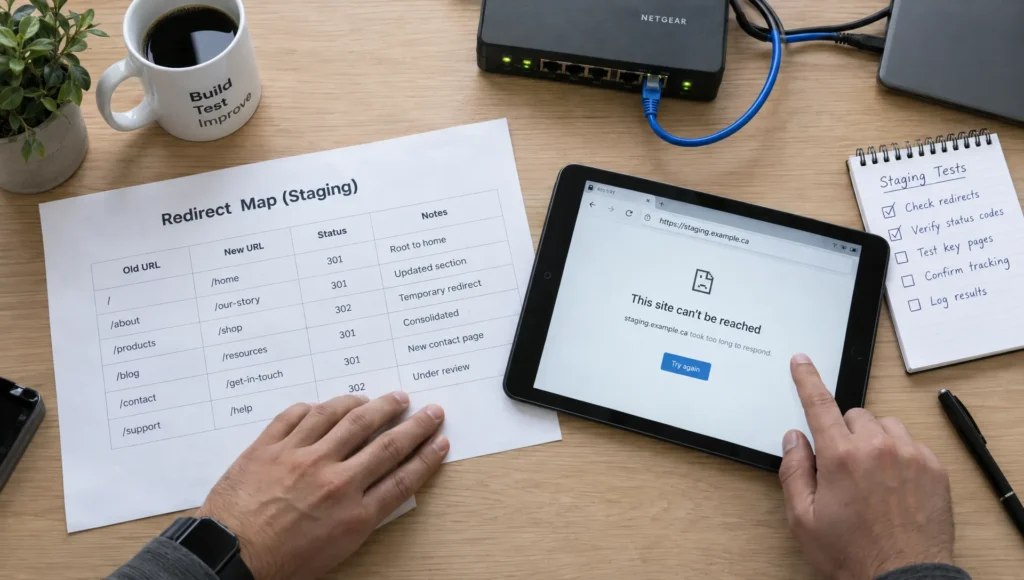
“Implemented” should mean the change works on the live website, not merely that a ticket moved to a completed column. Staging environments can differ from production in caching, robots directives, integrations and server configuration.
Verification should cover representative templates and important exceptions. If a change affects service pages, test several services and locations rather than just the homepage. Confirm that navigation, forms and booking journeys still work.
For a concrete service-business example, The Dental Studio on the Gold Coast presents treatment information, clinic details and booking links. On that type of website, a release check should confirm that visitors can move from treatment research to the intended contact or booking destination, not simply that a crawler reports fewer warnings. This illustrates a testing approach, not an assessment of that clinic's website.
Performance work needs equally clear tests. Google's Core Web Vitals guidance defines good thresholds as LCP of 2.5 seconds or less, INP of 200 milliseconds or less and CLS of 0.1 or less, assessed at the 75th percentile. Ask whether a performance claim comes from a lab test or real-user field data. They answer different questions, and field data takes time to reflect changes.
A fast lab result alone does not establish that real visitors across important page types now receive a consistently better experience.

Check platform and Canadian requirements
Test bilingual and multilingual implementation
A bilingual website requires more than a language switcher. Ask how the provider will verify language-specific URLs, canonical tags, internal links and appropriate hreflang annotations.
For English-Canadian and French-Canadian content, en-CA and fr-CA may be appropriate when they match the intended audiences. Google's localized versions documentation explains the annotation requirements, including return links between alternate pages.
A provider should distinguish localized equivalents from pages that merely discuss similar subjects. It should also test whether visitors and crawlers can reach each version without being forced into an unsuitable location or language redirect.
When comparing technical SEO services for a multilingual site, ask for an example of how the agency validates alternates across templates, not just its familiarity with a translation plugin.
Address regional pages and data handling
Regional service pages need consistent discovery paths, useful content and working conversion routes. Generating dozens of near-identical city pages is not a substitute for serving those markets. Ask how proposed architecture changes support genuine locations or service areas without creating unnecessary duplication.
Data access deserves its own discussion. Crawl exports, server logs, analytics and form integrations can expose information your business needs to control. Establish what the provider receives, where files are stored, who can access them and when access is removed.
Use least-privilege accounts rather than shared administrator credentials. Have the appropriate legal or privacy adviser review obligations that apply to your organization. Canadian hosting alone does not settle every privacy question, and technical work should not be presented as a blanket compliance guarantee.
Set a realistic first-90-day delivery plan
A proposal should show how delivery will begin without promising a ranking deadline. Dependencies vary, particularly when changes require a platform vendor or an internal development sprint.
Ask prospective providers to outline a provisional sequence like this:
| Period | Expected delivery focus | Evidence you should receive |
|---|---|---|
| Days 1 to 30 | Confirm access, establish baselines and prioritize significant issues | Agreed backlog, affected page groups and initial implementation tickets |
| Days 31 to 60 | Implement approved changes and validate releases | Change records, test results and documented blockers |
| Days 61 to 90 | Review post-release signals and refine priorities | Updated technical measurements, remaining risks and next actions |
This is an evaluation framework, not a promise that every site can follow the same schedule. An accidental sitewide indexing block may need immediate attention, while a complex migration requires a separate plan.
The first quarter of technical SEO services should produce an understandable record of decisions and completed work. If progress depends on your developers, the report should distinguish work awaiting approval from work awaiting implementation or search-engine processing.
Ask what happens when a dependency stalls. A useful provider escalates the blocker, explains the consequence and identifies other valuable work. It does not repeatedly bill for rediscovering the same unresolved issue.
Measure technical outcomes and business impact separately
Reporting should connect work to outcomes without pretending that every traffic movement has a single cause. Technical changes often happen alongside content updates, seasonal demand shifts and search algorithm changes.
Use three reporting layers. First, track delivery: approved tickets, released changes, validation results and unresolved blockers. Second, track technical effects on the intended page groups, such as fewer redirect chains, improved rendering or removal of accidental indexing restrictions. Third, examine business indicators such as relevant organic visits, qualified enquiries and completed bookings.
For technical SEO services, an increase in the total number of indexed pages is not automatically a success. A site may benefit from keeping duplicate filters, internal search results or obsolete pages out of the index. Measure the intended set of valuable pages rather than chasing a larger total.
Similarly, distinguish a successful fix from a ranking guarantee. You can verify that Google can access a page and that its directives are correct without guaranteeing when it will rank.
The boundary with content work should remain clear. Technical accessibility does not ensure that a page answers a customer's question. MarketingFlow's explanation of what an on-page SEO service actually fixes helps separate page-level relevance improvements from infrastructure work.
Frequently asked questions
What falls under technical SEO? Typical areas include crawling, indexability, redirects, canonicalization, site architecture, rendering, performance, structured data and migration support. Scope varies by platform and contract, so ask which areas include implementation rather than recommendations alone.
How much do technical SEO services cost? Pricing depends on site complexity, implementation responsibility, development effort and the engagement model. Request a written scope covering the retainer, separately billed work and dependencies. A low entry price for general SEO does not establish the cost of custom technical development.
Should every audit warning be fixed? No. Some warnings reflect intentional behaviour or low-value URLs. Prioritize issues using evidence, affected page importance, implementation effort and risk. Ask the provider to explain both what it recommends fixing and what it recommends leaving alone.
Can AI replace a technical SEO provider? AI can help summarize findings, draft tickets and assist with code. It does not remove the need to verify the diagnosis, approve production changes and test their consequences. Evaluate accountability and evidence rather than the tools used to produce the report.
Can an agency guarantee indexing or rankings? No. A provider can commit to defined work, acceptance criteria and reporting. Search engines control their own crawling, indexing and ranking decisions, which also depend on factors beyond the technical implementation.
Start with a scoped assessment
Before signing, request a sample implementation ticket, a responsibility breakdown and a description of post-release validation. Those three items reveal more about technical SEO services than a long list of audit checks.
MarketingFlow offers free SEO audits for Canadian businesses, with SEO plans starting at $99/month and no long-term contracts. Use the assessment to identify priorities, then confirm which technical changes are included, who will implement them and how completed work will be verified before choosing a plan.